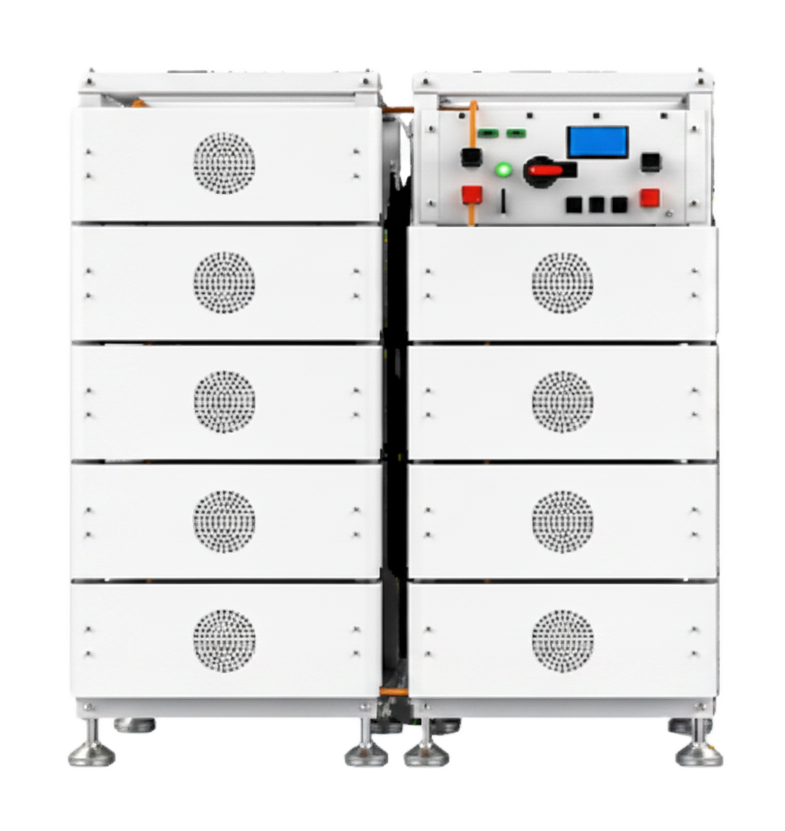
HV STACK MODULAR BASS . 64 KWH – 256 KWH . NATURAL CONVECTION

Modular HV stack BESS from 64 to 256 kWh.

Natural convection LFP. 4 to 16 modules per cluster. Inverter-coupled DC-only architecture — indoor installation, zero thermal management hardware.
HLY-BESS-COMMERCIAL-INDUSTRIAL-MODULAR-16KWH . 16KWH MODULE . 204.8V TO 819.2 CLUSTER
Natural convection. Modular. DC-only. Chinese scale. Global service.
AT A GLANCE

Henley Power’s modular high-voltage stack BESS for commercial and industrial applications. Each module is 16 kWh nominal at 51.2 V / 314 Ah; clusters of 4 to 16 modules in series give a system range of 64 to 256 kWh, with DC bus voltage scaling from 204.8 V to 819.2 V. Natural convection LFP cooling — no fans, no chiller, no heat exchanger. 8,000 cycles at 80% DoD per IEC 62619. Manufactured in Dezhou, Shandong. European projects serviced from Romania.

8,000

Cycles
80% DoD · 0.3C · 25 °C · per IEC 62619

IP21

Indoor Enclosure
Electrical room or BESS room

5+5 yr

Insurance-backed option

35 d

Ex-works Dezhou, Shandong
WHY SPECIFIERS CHOOSE MODULAR OVER MONOBLOCK

Four reasons the modular rack wins on €/kWh.

Most commercial-industrial BESS ships as a fixed-size cabinet with an integrated PCS. That bundling carries 18 to 25% cost overhead that disappears when air-cooling and DC-only architecture take over.
No chiller · No glycol loop · ~18–25% BoM saving

Air-Cooling Removes a Cost Block

A liquid-cooled BESS carries a chiller, glycol pumps, cold-plate manifold, and the controls to balance flow across modules. That hardware is roughly 18 to 25% of the BoM. Air-cooling needs fans, intake filters, and exhaust paths. The cost gap is real and shows up at the invoice.
DC-only · Customer chooses inverter · Open BMS protocol

The PCS Market Is Already Commoditised

String PCS, hybrid inverters, and central PCS are sold by Sungrow, SMA, Sineng, Sofar, Goodwe, Hopewind, Deye, and Victron at competitive prices. Bundling a captive PCS into a sealed BESS forces a margin stack onto the buyer. Shipping DC-only lets the customer or EPC source the inverter where pricing already favours them.
4 to 16 modules · 64 kWh to 256 kWh · 16 kWh steps

Pay for the Capacity You Need

A monoblock cabinet sized for 261 kWh is still 261 kWh when the project needs 128 kWh. That’s stranded capex from day one. The modular HV stack scales in 16 kWh steps. A site that needs 128 kWh buys 8 modules. When it needs 192 kWh, it adds 4 more. Capacity matches the actual load.
No fan · No chiller · No moving parts · Silent operation

Natural Convection Removes Maintenance Risk

Forced-air BESS needs fan replacement cycles, filter cleaning schedules, and bearing-failure monitoring. Natural convection has none of those. The thermal path is passive physics — heat rises through the module stack and exits at the top. Factory thermal report on file confirms this works across the full 64-256 kWh range.
TECHNICAL SPECIFICATIONS

One module. Four to sixteen cluster sizes.

All specifications below apply to a single 16 kWh module. Cluster performance scales linearly with module count. DC bus voltage scales from 204.8 V (4 modules) to 819.2 V (16 modules) in direct proportion to module count.
HLY-DS-Commercial-Industrial-Modular-16kWh · v1.0 · May 2026

Parameter

16 kWh module · natural convection · DC-only

HLY-BESS-Commercial-Industrial-Modular-16kWh

Battery System
Module Nominal Energy16 kWh (16.07 kWh nominal)
Module Nominal Voltage51.2 V
Cell ChemistryLiFePO₄ — Cobalt-Free · EU Reg 2023/1542 · Tier-1 cells from publicly listed manufacturers, multi-supplier homologated
Cluster Voltage Range204.8 V (4 modules) to 819.2 V (16 modules)
Module Cell Capacity314 Ah (51.2 V × 314 Ah)
Modules per Cluster4 minimum · 16 maximum (single integer steps)
Cluster Capacity Range64 kWh (4 modules) – 256 kWh (16 modules)
Cycle Life8,000 cycles at 80% DoD · 0.3C · 25 °C · EOL 70% SOH · per IEC 62619 · cell-level data under NDA
Cycle Life at 50% DoD≥10,000 cycles
Warranty5 years standard · 5 years optional extension · whichever limit (years or cycle count) is reached first
Battery Management System (BMS)
BMS Architecture3-tier: module BMS · cluster BCMU · system BCU
Cell Voltage Accuracy±5 mV
Temperature Monitoring4 sensors per module · ΔT alarm at 5 °C
Active BalancingYes · ≥1 A balancing current
Communication (BMS-level)RS485 Modbus RTU · CAN 2.0B
Thermal Management & Environment
Cooling MethodNatural convection · fanless · no filters · no moving thermal parts
Operating TemperatureCharge: 0 °C to +50 °C · Discharge: −10 °C to +50 °C · Derate above 45 °C
Storage Temperature−20 °C to +55 °C
Humidity5–95% non-condensing
Maximum Operating Altitude3,000 m
Enclosure & Physical
Module EnclosureIP21 indoor · powder-coated steel
Module Dimensions (W×D×H)690 × 500 × 240 mm
Module Weight~110 kg per module
Stack ConfigurationFloor-standing vertical stack · 160 mm base + 240 mm × n modules
Stack Footprint0.345 m² per stack (constant across all configurations)
Safety & Fire Protection
Cell-Level ProtectionVent design · ceramic separator · thermal runaway propagation tested per UL 9540A method
Module-Level ProtectionFuse · contactor · isolation monitoring · smoke detection
System Fire SuppressionProject-specific — aerosol or Novec 1230 recommended · sized per room volume
Communication & Control
Module / Cluster CommsRS485 Modbus RTU · CAN 2.0B
System EMS ProtocolsModbus TCP · IEC 61850-7-420 (DER profile) · IEC 60870-5-104 · DNP3 over Ethernet
SCADA IntegrationStandard data points exposed · full register map supplied with order
Service & Delivery
Service Network9-region active and expansion service network · EU service hub in Romania · spare module stock held in-region
Standard Response72 hours fault diagnosis · 5–10 working days module replacement
Lead Time35 days from confirmed order, ex-works Dezhou, Shandong
Minimum Order1 cluster (4 modules · 64 kWh)
All values per IEC 62933-2-1. Specifications subject to change without notice. Final specifications confirmed per project at contract phase.
THREE DEPLOYMENT TOPOLOGIES

Pair the cluster with the inverter the project needs.

The cluster ships DC-only with RS485 Modbus RTU and CAN 2.0B. Inverter selection sits with the customer or EPC. All three topologies below have been deployed commercially.
Mode A — String PCS

Cluster + String PCS

Cluster pairs with a high-voltage hybrid or string PCS rated for 204.8–922 Vdc input. Standard architecture for grid-tied commercial peak-shaving and demand-charge applications. Compatible with Pylontech-protocol devices, Growatt, Goodwe, SofarSolar, Deye, Ginlong (Solis), and SMA. Pairing’s confirmed per project before order.
SKU: HLY-BESS-Commercial-Industrial-Modular-16kWh-DC
Typical PCS: 30–200 kW per unit
Mode B — Hybrid Inverter

Cluster + Hybrid Inverter

Cluster pairs with a high-voltage hybrid inverter combining PV input and battery DC bus. Standard architecture for sites combining rooftop or carport PV with storage, or for grid-forming island-mode operation. Deye, Goodwe, Sofar HYD, Victron MultiPlus, and SMA Sunny Tripower-S are validated pairings. RS485 and CAN handshake verified before shipment.
SKU: HLY-BESS-Commercial-Industrial-Modular-16kWh-DC + HLY-Inverter-Hybrid
Typical inverter: 30–125 kW per unit
Mode C — Central PCS

Multi-Cluster + Central PCS

Multiple clusters paralleled at the DC bus and connected to a central PCS rated 630 kW to 2.5 MW. Standard architecture for the upper end of the modular range — sites running 1.5 to 2.5 MWh where a single large inverter is more cost-effective. MV transformer interconnection typical.
SKU: HLY-BESS-Commercial-Industrial-Modular-16kWh-DC + central PCS
Typical central PCS: 200 kW – 1.0 MW
Parameter
Mode A · Integrated
Mode B · Central PCS
Mode C · Hybrid Inverter
PCS source
On-board, integrated in cabinet
External central PCS, separate skid
External hybrid inverter (PV + BESS)
Rated AC power
200 kW (215, 225 kW optional)
630 / 1,000 / 1,250 / 1,500 / 2,000 / 2,500 kW
30 / 50 / 60 / 100 / 125 kW
Typical scale
1–10 cabinets · 0.4–4.2 MWh
4–40 cabinets · 1.7–16.7 MWh
1–4 cabinets · 0.4–1.7 MWh
Typical sites
C&I behind-the-meter, single-cabinet retrofits
Utility BESS, large industrial, FCR/aFRR plants
Solar-plus-storage rooftops, microgrids
SKU
HLY-BESS-Commercial-Industrial-418kWh
HLY-BESS-Commercial-Industrial-418kWh-DC
HLY-BESS-Commercial-Industrial-418kWh-DC + HLY-Inverter-Hybrid
Spec table reflects Mode A. Battery, BMS, thermal, and EMS identical across all three modes — only PCS strategy differs. Sizing and pairing confirmed per project at engineering review.
SYSTEM ARCHITECTURE

Built for 10 years of inverter-coupled operation.

LFP · 51.2 V module · multi-supplier · cobalt-free

Cell & Battery System

Tier-1 LFP cells from publicly listed manufacturers, multi-supplier homologated. Each 314 Ah module carries LiFePO₄ prismatic cells — the most thermally stable, most cycle-proven chemistry for indoor commercial BESS. Cobalt-free. No active cooling required. Cell-level fusing and vent design tested per IEC 62619. Specific supplier identification releases after NDA execution.
DC bus exposed · 204.8–819.2 V · customer PCS selection

Power Conversion (Customer-Supplied)

DC bus exposed at the cluster output. Voltage scales with module count: 204.8 V at 4 modules to 819.2 V at 16 modules. Compatible with high-voltage hybrid inverters, string PCS, or central PCS depending on site economics. The cluster ships DC-only. BMS communicates via RS485 Modbus RTU and CAN 2.0B simultaneously to any compliant PCS or EMS.
Cell-level monitoring · overcharge · over-temperature · SoC/SoH

Battery Management System (BMS)

Integrated BMS runs real-time monitoring across every cell in every module — voltage, temperature, state of charge, and state of health. Hard protection limits against overcharge, over-discharge, overcurrent, and thermal exceedance. Active balancing ensures uniform cell utilisation across the cluster lifetime. Communicates upstream via RS485 (Modbus RTU) and CAN 2.0B simultaneously.
Modbus TCP · IEC 61850-7-420 · IEC 104 · DNP3 · ENTSO-E

EMS & Communication

System-level EMS supports Modbus TCP, IEC 61850-7-420 (DER profile), IEC 60870-5-104, and DNP3 over Ethernet. Compatible with major European TSO grid codes including ENTSO-E network code requirements. Specific TSO qualification is confirmed per project at commissioning against the operator’s interconnection agreement. OTA firmware updates available.

Single-line diagram — DC stack cluster · PCS interface · LV bus

WHERE THIS PLATFORM DEPLOYS

Six commercial buyer verticals deployed.

Each vertical sizing example below assumes typical European C&I load profiles. Final cluster sizing depends on metered load data, tariff structure, and backup requirements.

Small Offices & Retail Stores

Office buildings under 2,000 m² and retail stores draw 20–60 kW base load with afternoon peaks. A 6-module cluster (96 kWh, 307 V) covers a typical retail demand-charge cycle on a 100 kW connection. PV self-consumption mode absorbs rooftop export during business hours. The indoor IP21 stack footprint is 0.345 m² — fits most electrical rooms without civil work.

EV Charging Hubs

Highway and urban DC fast-charging hubs with three to six 150 kW chargers see instantaneous grid spikes that trigger demand penalties or require grid reinforcement. A 6 to 9 module cluster (193–290 kWh) buffers those spikes — the battery discharges during charging events and recharges between sessions. For 350 kW HPC hubs, cluster sizing scales with simultaneous-charging load. DC-coupled deployment minimises conversion losses.

Supermarkets & Food Retail

Supermarkets run 24/7 refrigeration loads of 80–200 kW baseline plus checkout, lighting, and HVAC. A 6-module cluster (193 kWh) handles evening demand charges on a 250 kW connection while holding capacity for refrigeration backup — typically 30 to 60 minutes of hold-up. ToU arbitrage runs daily on the refrigeration baseload. Sizing depends on store class and local tariff.

Cold Storage & Cold Chain

Cold storage warehouses up to 1,500 m² and refrigerated logistics hubs need continuous power for chambers and dock systems. A 10 to 15 minute outage spoils inventory — there’s no buffer. A 3 to 6 module cluster (96 to 193 kWh) runs continuous ToU arbitrage on refrigeration baseload and switches to backup on grid loss. Hold time depends on cluster size and load.

Telecom & Edge Infrastructure

Telecom base stations, edge data nodes, and small ISP hubs need 24/7 power continuity for 5–30 kW loads. A 3-module cluster (96 kWh) provides 3 to 12 hours backup at full load — longer at partial loads. Daily ToU cycling on the active grid connection generates economic return alongside the backup reserve. Indoor IP21 fits standard telecom enclosures; DC-coupled deployment with site rectifiers is the most common architecture.

Small Industrial & Manufacturing

Workshop-scale metalworking, plastics, and light manufacturing facilities draw 100–400 kW with sharp process-driven peaks. A 6 to 15 module cluster (193–483 kWh) covers demand-charge management on a 500 kW connection and provides 15 to 45 minute backup for critical processes. PV self-consumption pairs naturally with rooftop solar on manufacturing roofs. Sizing depends on process load profile and backup criticality — we don’t publish a one-size answer here.
REGULATORY READINESS

Certified for European deployment.

Test reports available under NDA on request. Full bankability package provided for project finance lender due diligence.

IEC 62619

IEC 62933-2-1

IEC 62477-1

CE Declaration

UN 38.3

UN 3536

EU Reg 2023/1542

UL 9540A method

ISO 9001:2015

ISO 14001:2015

ISO 45001:2018

RoHS

LiFePO₄ chemistry contains no cobalt, no nickel, no manganese. The supply-chain due-diligence burden under EU Regulation 2023/1542 is substantially lower than for NMC chemistries. CE marked. Carbon footprint declarations available for projects with the 18 February 2027 compliance deadline. Battery passport documentation prepared on request. EU-jurisdiction warranty service from Romania, with spare parts stocked in-region for European projects.

Project finance ready
Direct manufacturer warranty · 5+5yr coverage (insurance-backed option) · DFI track record (China + Chad) · IEC test reports under NDA · FSR documentation per-tender
FREQUENTLY ASKED QUESTIONS

Questions from installers, engineers, and buyers.

What configurations are available — can I order an intermediate module count?
Any integer from 4 to 16 modules per cluster is a valid configuration. We commonly quote 4, 8, 12, and 16 modules because those map cleanly to round system kWh figures: 64, 128, 192, and 256 kWh. But 7 modules (112 kWh), 11 modules (176 kWh), or any other count is orderable with no premium. Stack height adjusts accordingly: 160 mm + 240 mm × n modules. DC bus voltage scales with module count: 204.8 V at 4 modules to 819.2 V at 16 modules.
8,000 cycles at 80% depth of discharge, 0.3C charge and discharge rate, 25°C ambient, tested per IEC 62619. The warranty covers whichever’s reached first: the 5-year period or the contracted cycle count. Real-world cycling at shallower DoD and moderate temperatures will extend calendar life further — but we quote the 80% DoD figure because that is the test condition, not a marketing optimum.
The system communicates via RS485 (Modbus RTU) and CAN simultaneously, and is compatible with high-voltage hybrid and string inverters from publicly listed manufacturers — Pylontech-protocol devices, Growatt, Goodwe, SofarSolar, Victron Energy, Deye, Ginlong (Solis), and SMA. We verify protocol handshake with the customer’s exact inverter model and firmware version before order confirmation, not after shipment. If your inverter isn’t on the homologated list, send the model number and we evaluate within 3-5 working days.
Standard warranty is 5 years on the battery system, extendable to 5+5 years under contract. Coverage includes parts and labour for manufacturing defects across the full system. Warranty insurance via licensed European insurer is available as a project option for DFI-financed and institutionally-backed tenders. Parent guarantee or escrow alternative on request. Service execution is contractually committed to the European hub in Romania — parts logistics, on-site dispatch, emergency response. No shipping-back-to-factory clause.
No outdoor installation. The IP21 protection class covers vertical water drip only — not rain, humidity exposure, or dust ingress at the level required for outdoor siting. The system is engineered for indoor installation: equipment rooms, basements, MV/LV switchrooms, utility spaces. Natural convection’s rated across the full 64-256 kWh range per the factory thermal report on file. Operating envelope is -10°C to +50°C ambient; above 45°C, derating curves apply per the technical datasheet, provided under NDA on request.
Compatible with major European TSO grid codes including ENTSO-E network code requirements. Specific TSO qualification (50Hertz, TenneT, RTE, Energinet, National Grid ESO, Transelectrica, and others) is confirmed per project, validated at commissioning. IEC 61850-7-420 DER profile is supported. Certifications include CE marking, IEC 62619 (cell safety), UL 1642 (cell), UN 38.3 (transport), and EU Battery Regulation 2023/1542 — battery passport architecture in place for the 18 February 2027 mandatory deadline. Test reports under NDA.
Lead time is quoted per order based on configuration size, current production schedule, and shipping route. Every order is individual on lead time. Standard delivery is CFR or CIF to European ports; DDP terms available for larger orders. Minimum order is 1 cluster (4 modules). Project pricing is available from 3 clusters. We can hold stock for confirmed repeat customers under framework agreements.
Henley Power contracts as direct manufacturer with single-signatory accountability — direct manufacturer warranty, 5+5yr coverage with insurance-backed option, DFI track record (China + Chad), IEC test reports under NDA, and FSR documentation per-tender. Track record includes utility-scale ESS deployments in Inner Mongolia, Ningxia, Shandong, Hebei, and Henan, plus a PV-storage-diesel project in Chad. Full bankability documentation at /bankability/.
REQUEST A QUOTE OR DATASHEET

Talk to engineering.

Engineering response within 24 hours. We cover capacity sizing, grid code review, inverter selection guidance, and preliminary SLD as part of the pre-contract package.

Send your inquiry.

"*" indicates required fields

By submitting you agree to be contacted regarding this inquiry. Data handled per GDPR.
REQUEST A QUOTE OR DATASHEET

Talk to engineering.

Engineering response within 24 hours. We cover capacity sizing, grid code review, inverter selection guidance, and preliminary SLD as part of the pre-contract package.

What you get

By submitting you agree to be contacted regarding this inquiry. Data handled per GDPR.

By submitting you agree to be contacted regarding this inquiry. Data handled per GDPR.
RELATED PRODUCTS

Other products in the Henley Power range.

HLY-BESS-Commercial-Industrial-Modular-32kWh

32 kWh air-cooled modular rack
Air-cooled. 3 to 78 modules per cluster, 96 kWh to 2.5 MWh. Forced-air thermal management. Same DC-only inverter-coupled architecture. For sites needing larger cluster capacity beyond 256 kWh.

HLY-BESS-Commercial-Industrial-261kWh

261 kWh liquid-cooled all-in-one
Integrated PCS, liquid-cooled, outdoor IP55. For C&I sites needing a fixed-capacity turnkey solution with integrated power conversion. Three deployment modes supported.

HLY-Inverter-Hybrid

Hybrid inverter for Mode B pairing
Henley Power hybrid inverter, compatible with Mode B topology on this modular cluster. Combines PV input and battery DC bus. Sized 30–125 kW. Specifications and bankability package issued per project.

UTILITY

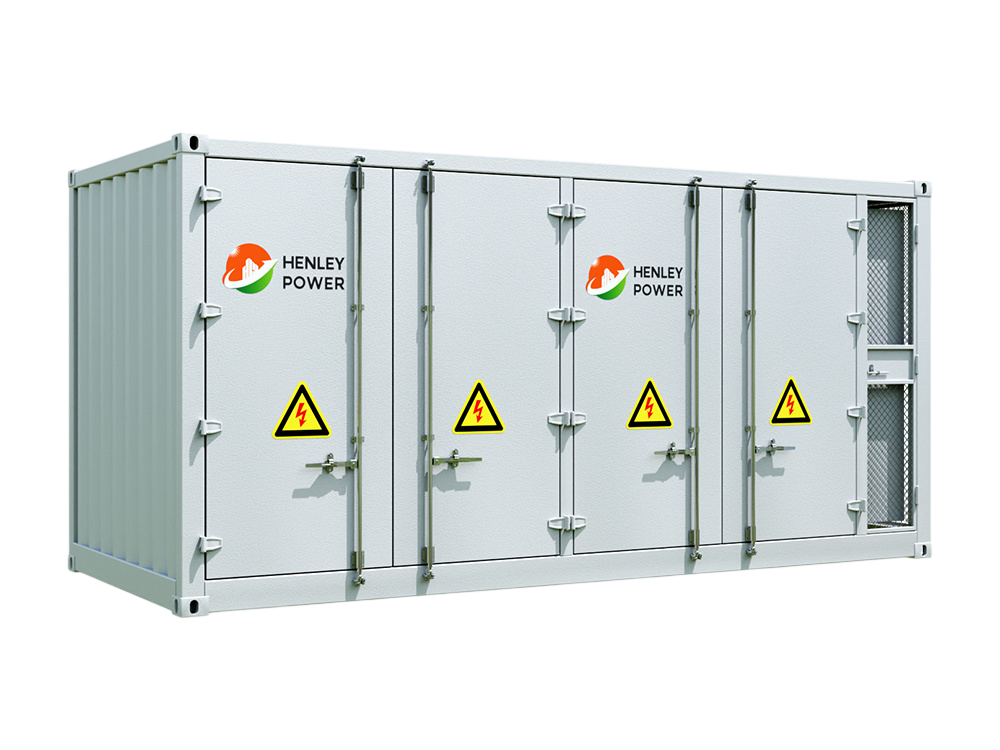
HLY-BESS-Utility-3MWh · 4MWh · 5MWh

Utility-Scale BESS — 3 to 5 MWh Liquid-Cooled Container.

3–5 MWh

3,344 / 4,180 / 5,015 kWh liquid-cooled LFP in 20-ft ISO containers — grid-scale storage, frequency response, BESS-as-a-service.

View product

RESIDENTIAL · STACKABLE

HLY-BESS-Residential-16kWh

HLY-BESS-Residential-16kWh

16 kWh

Stackable floor-standing LFP home battery. 16 kWh per unit, 51.2 V, 314 Ah. Parallel-expandable to 240 kWh.

View product

C&I · LIQUID-COOLED

HLY-BESS-Commercial-Industrial-418kWh

200 kW / 418 kWh in one outdoor cabinet.

418 kWh

200 kW / 418 kWh liquid-cooled outdoor cabinet at 1,331 Vdc — industrial peak-shaving, data centres, large commercial portfolios.

View product