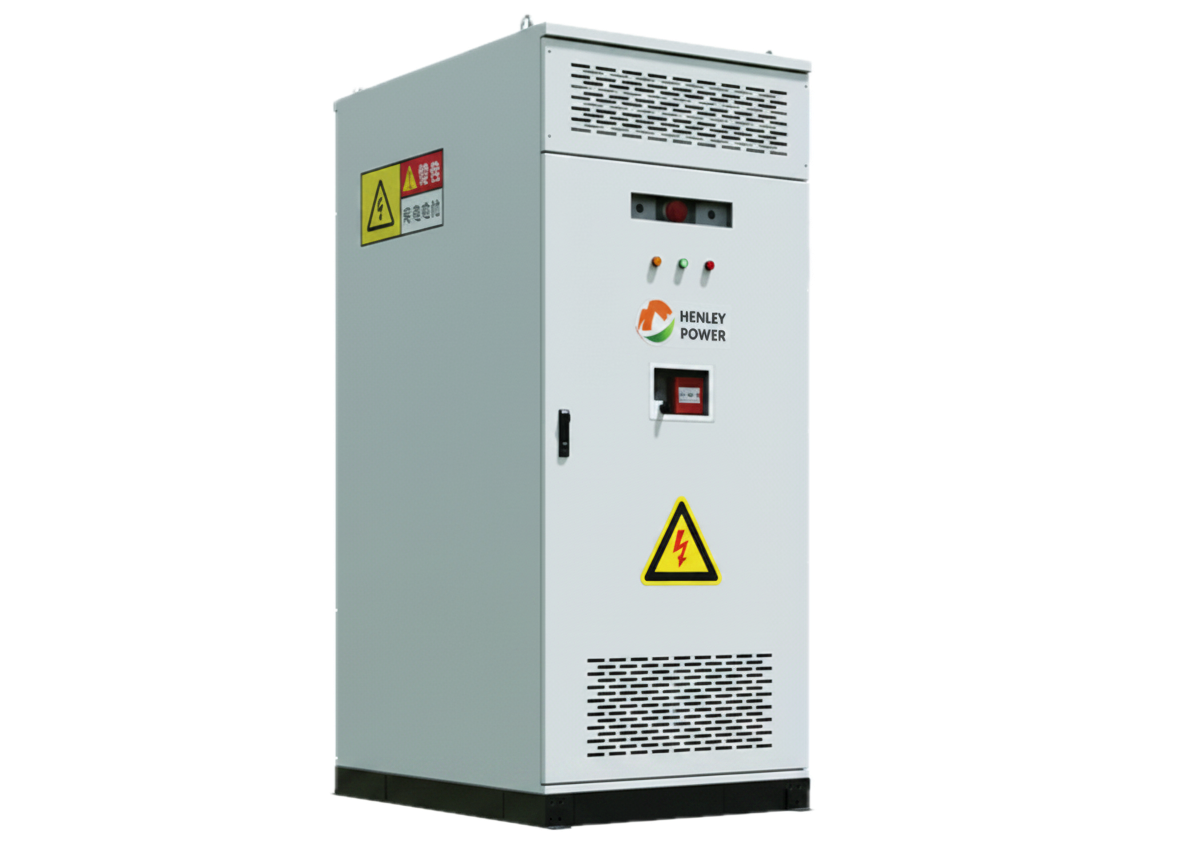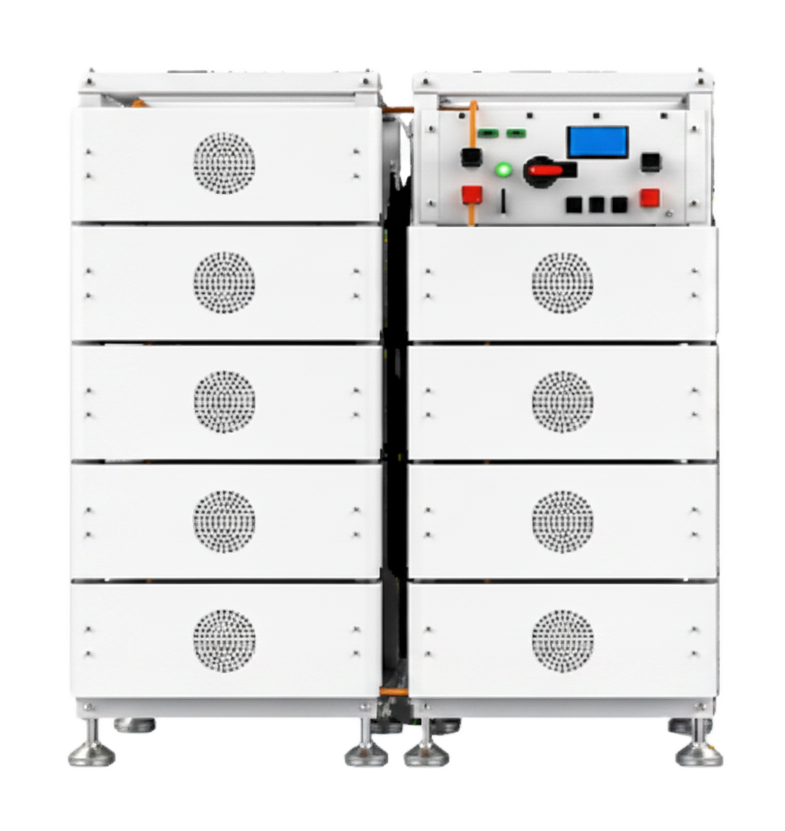
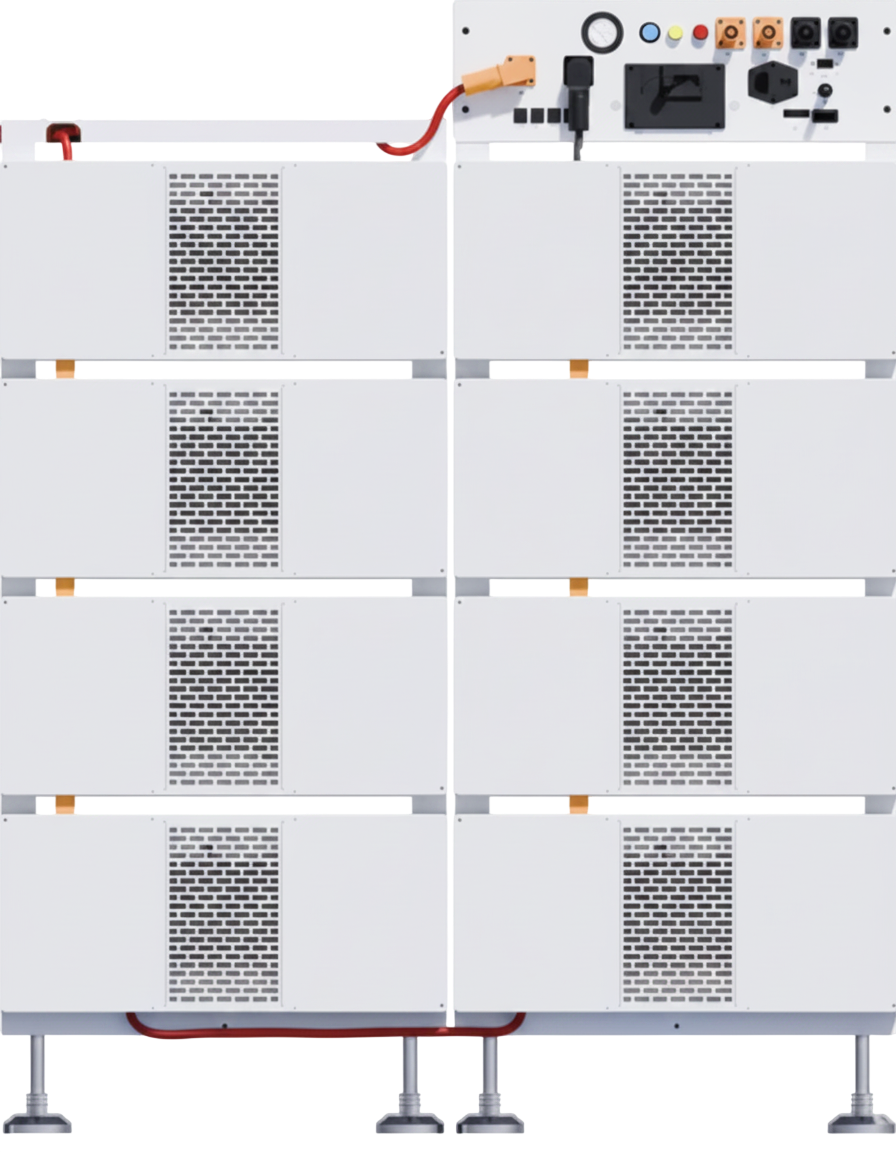
AIR- COOLED ODULAR RACK BESS . 96 KWH – 2.5MWH

The most economical path from 96 kWh to 2.5 MWh.

Commercial energy storage for small offices, retail stores, EV charging hubs, supermarkets, and telecom sites — across European C&I deployments.
HLY- BESS-COMMERCIAL-INDUSTRIAL-MODULAR-32KWH .32.2KWH MODULE . 768 V OPR 819 CLUSTER
Air-cooled. Modular. DC-only. Lowest €/kWh in commercial-industrial storage.
AT A GLANCE
Henley Power’s modular battery energy storage system powers small offices, retail stores, EV charging hubs, supermarkets, and telecom sites across European C&I deployments. The 32.2 kWh LiFePO₄ module scales 3 to 78 units per cluster — 96 kWh to 2.5 MWh — covering everything from a 200 kW retail demand-charge cluster to a 2 MW industrial park microgrid. Air-cooled IP21 indoor enclosure delivers the lowest €/kWh in its commercial energy storage segment. Manufactured in Dezhou, Shandong. European projects serviced from Romania across a 9-region service network.

8000

Cycles
80% DoD · 0.5C · 25 °C · per IEC 62619

IP21

INDOOR ENCLOSURE
ELECTRICAL ROOM OR BESS ROOM

5+5 yr

INSURANCE-BACKED OPTION

35 d

EX-WORKS DEZHOU, SHANDONG
WHY SPECIFIERS CHOOSE MODULAR OVER MONBLOCK

Four reasons the modular rack wins on €/kWh.

Most commercial-industrial BESS ships as a fixed-size cabinet with an integrated PCS. That bundling carries 18 to 25% cost overhead that disappears when air-cooling and DC-only architecture take over.
NO CHILLER. NO GLYCOL LOOP. ~ 18-25% BOM SAVING

Air-Cooling Removes A Cost Block.

A liquid-cooled BESS carries a chiller, glycol pumps, cold-plate manifold, and the controls to balance flow across modules. That hardware is roughly 18 to 25% of the BoM. Air-cooling needs fans, intake filters, and exhaust paths. The cost gap is real and shows up at the invoice.
DC- ONLY. CUSTOMNER CHOOSE INVERTER. OPEN BMS PROTOCOL

The PCS Market Is Already Commoditised.

String PCS, hybrid inverters, and central PCS are sold by Sungrow, SMA, Sineng, Sofar, Goodwe, Hopewind, Deye, and Victron at competitive prices. Bundling a captive PCS into a sealed BESS forces a margin stack. Shipping DC-only lets the customer or EPC source the inverter where pricing already favours them.
3 TO 78 MODULES· 96 KWH TO 2.5 MWH· 32.2 KWH STEPS

Pay For The Capacity You Need.

A monoblock cabinet sized for 261 kWh is still 261 kWh when the project requires 180 kWh. The modular rack scales in 32.2 kWh increments. A site that needs 480 kWh buys 15 modules. A site that grows to 800 kWh adds 10 more. Capacity matches load — no stranded capex.
35-DAY LEAD TIME ]· PALLET DELIVERY. INDOOR INSTALL

Faster To Delivery, Simpler To Install.

Modules ship on standard pallets, not in a 20-foot container. Indoor IP21 deployment removes weatherisation, foundation pad, and structural fees. A small electrical room, a standard rack, three to twelve modules per rack. No crane, no civil work, no outdoor commissioning window.
TECHNICAL SPECIFICATIONS

One Module. Many cluster sizes.

All specifications below apply to a single 32.2 kWh module. Cluster performance scales linearly with module count. Cluster voltage depends on series string configuration: 30-module strings reach 768 V nominal; 32-module strings reach 819 V nominal.
HLY-DS-Commercial-Industrial-Modular-32kWh · v1.0 · May 2026

Parameter

32.2 kWh module · air-cooled · DC-only

HLY-BESS-Commercial-Industrial-Modular-32kWh

Battery System
Module Nominal Energy32.2 kWh
Module nominal voltage25.6 V
Cell chemistryLiFePO₄ — Cobalt-Free · EU Reg 2023/1542 · Tier-1 cells from publicly listed manufacturers, multi-supplier homologated
Cluster Voltage Range696–922 V (operating)
Cluster Nominal Voltage768 V (30-module string) or 819 V (32-module string)
Modules per Cluster3 minimum · 78 maximum
Cluster Capacity Range96.6 kWh – 2,511.6 kWh
Cycle Life8,000 cycles at 80% DoD · 0.5C · 25 °C · EOL 70% SOH · per IEC 62619 · cell-level data under NDA
Cycle Life at 50% DoD≥10,000 cycles
Warranty5 years standard · 5 years optional extension · whichever limit (years or cycle count) is reached first
Battery Management System (BMS)
BMS Architecture3-tier: module BMS · cluster BCMU · system BCU
Cell Voltage Accuracy±5 mV
Temperature Monitoring4 sensors per module · ΔT alarm at 5 °C
Active BalancingYes, ≥ 1 A balancing current
Communication (BMS-level)RS485 Modbus RTU · CAN 2.0B
Thermal Management & Environment
Cooling methodForced-air · intake/exhaust fans · intake filtration
Operating Temperature−10 °C to +50 °C (full power) · −20 °C to +55 °C (derated)
Storage Temperature−30 °C to +60 °C
Humidity5–95% non-condensing
Maximum Operating Altitude≤2,000 m without derating · up to 4,000 m derated
Enclosure & Physical
Module enclosureIP21 indoor, powder-coated steel
Module dimensions (W×D×H)442 × 600 × 240 mm
Module weight≤ 285 kg
Rack configuration2-, 3-, or 4-module columns; 19-inch standard rails
InstallationIndoor only, electrical room or dedicated BESS room
Safety & Fire Protection
Module EnclosureIP21 indoor · powder-coated steel
Module Dimensions (W×D×H)442 × 600 × 240 mm
Module Weight≤285 kg
Communication & Control
Module / cluster commsRS485 Modbus RTU · CAN 2.0B
System EMS protocolsModbus TCP · IEC 61850-7-420 DER profile · IEC 60870-5-104 · DNP3 over Ethernet
SCADA integrationStandard data points exposed; full register map supplied with order
Rack Configuration2-, 3-, or 4-module columns · 19-inch standard rails
Installation RequirementIndoor only · electrical room or dedicated BESS room
Safety & Fire Protection
Cell-Level ProtectionVent design · ceramic separator · thermal runaway propagation tested per UL 9540A method
Module-Level ProtectionFuse · contactor · isolation monitoring · smoke detection
System Fire SuppressionProject-specific — aerosol or Novec 1230 recommended · sized per room volume
Communication & Control
Module / Cluster CommsRS485 Modbus RTU · CAN 2.0B
System EMS ProtocolsModbus TCP · IEC 61850-7-420 (DER profile) · IEC 60870-5-104 · DNP3 over Ethernet
SCADA IntegrationStandard data points exposed · full register map supplied with order
Service & Delivery
Service Network9-region active and expansion service network · EU service hub in Romania · spare module stock held in-region
Standard Response72 hours fault diagnosis · 5–10 working days module replacement
Lead Time35 days from confirmed order, ex-works Dezhou, Shandong
Minimum Order3 modules (96.6 kWh)
All values per IEC 62933-2-1. Specifications subject to change without notice. Final specifications confirmed per project at contract phase.
THREE DEPLOYMENT TOPOLOGIES

Pair the cluster with the inverter the project needs.

The cluster ships DC-only with RS485 Modbus RTU and CAN 2.0B. Inverter selection sits with the customer or EPC. All three topologies below have been deployed commercially.
Mode A — String PCS

Cluster + string PCS

Cluster pairs with one or more string PCS rated for 696 to 922 Vdc input. Standard architecture for grid-tied commercial peak-shaving and demand-charge applications. Sungrow SC, Sineng EP, Hopewind PowerWind, and equivalents qualify if voltage range matches.
SKU: HLY-BESS-Commercial-Industrial-Modular-32kWh-DC
Typical sizing: 100–500 kW per PCS
Mode B — Hybrid inverter

Cluster + hybrid inverter

Cluster pairs with a hybrid inverter that combines PV input and battery DC bus on the same chassis. Standard architecture for sites combining rooftop or carport PV with storage, or for grid-forming island-mode operation. Deye, Goodwe, Sofar HYD, Victron MultiPlus, SMA Sunny Tripower-S typical pairings.
SKU: HLY-BESS-Commercial-Industrial-Modular-32kWh-DC + HLY-Inverter-Hybrid
Typical inverter: 30–125 kW per unit
Mode C — Central PCS

Multi-cluster + central PCS

Multiple clusters paralleled at the DC bus and connected to a central PCS rated 630 kW to 2.5 MW. Standard architecture for the upper end of the modular range — sites running 1.5 to 2.5 MWh where a single large inverter is more cost-effective. MV transformer interconnection typical.
SKU: HLY-BESS-Commercial-Industrial-Modular-32kWh-DC + central PCS Typical sizing: 630 kW – 2.5 MW
central PCS
Parameter
Mode A · Integrated
Mode B · Central PCS
Mode C · Hybrid Inverter
PCS source
On-board, integrated in cabinet
External central PCS, separate skid
External hybrid inverter (PV + BESS)
Rated AC power
200 kW (215, 225 kW optional)
630 / 1,000 / 1,250 / 1,500 / 2,000 / 2,500 kW
30 / 50 / 60 / 100 / 125 kW
Typical scale
1–10 cabinets · 0.4–4.2 MWh
4–40 cabinets · 1.7–16.7 MWh
1–4 cabinets · 0.4–1.7 MWh
Typical sites
C&I behind-the-meter, single-cabinet retrofits
Utility BESS, large industrial, FCR/aFRR plants
Solar-plus-storage rooftops, microgrids
SKU
HLY-BESS-Commercial-Industrial-418kWh
HLY-BESS-Commercial-Industrial-418kWh-DC
HLY-BESS-Commercial-Industrial-418kWh-DC + HLY-Inverter-Hybrid
Spec table reflects Mode A. Battery, BMS, thermal, and EMS identical across all three modes — only PCS strategy differs. Sizing and pairing confirmed per project at engineering review.
SYSTEM ARCHITECTURE

Built for ten years of indoor commercial operation.

LFP · 25.6 V module · 3-tier BMS · Tier-1 multi-supplier

Cell & battery system

LiFePO₄ Tier-1 prismatic cells from publicly listed manufacturers, multi-supplier homologated for supply continuity. Cell-level fusing, vent design, and thermal runaway propagation tested per UL 9540A method. Module-level fire suppression points integrated for room-level retrofit.
DC bus exposed · 696–922 V · customer PCS selection

Power conversion (customer-supplied)

DC bus exposed at the cluster output. Voltage range 696 V to 922 V. Compatible with string PCS, hybrid inverter, or central PCS depending on site economics. The cluster does not include a captive PCS — that’s the cost-leader decision.
3-tier · ±5 mV · ΔT alarm 5 °C · active balancing ≥1 A

Battery management system

Three-tier BMS — module BMS for cell-level monitoring and balancing, cluster BCMU for string-level coordination, system BCU for cluster aggregation. Cell voltage accuracy ±5 mV. Active balancing ≥ 1 A. RS485 Modbus RTU and CAN 2.0B at module and cluster, expandable upward through EMS.
Modbus TCP · IEC 61850-7-420 · IEC 104 · DNP3 · ENTSO-E

EMS & communication

System-level EMS supports Modbus TCP, IEC 61850-7-420 DER profile, IEC 60870-5-104, and DNP3 over Ethernet. Compatible with major European TSO grid codes including ENTSO-E network code requirements. Specific TSO qualification confirmed per project at commissioning.

Single-line diagram — DC cluster · PCS interface · LV bus

WHERE THIS PLATFORM DEPLOYS

Six commercial buyer verticals deployed.

Each vertical sizing example below assumes typical European C&I load profiles. Final cluster sizing depends on metered load data, tariff structure, and backup requirements.

Small Offices & Retail Stores

Office buildings under 2,000 m² and retail stores draw 20-60 kW base load with afternoon peaks. A 3-module cluster (96 kWh, 768 V class) covers a typical retail demand-charge cycle on a 100 kW connection. PV self-consumption mode absorbs rooftop export during business hours. Indoor IP21 enclosure suits utility rooms and storage areas. Payback depends on the local demand charge tariff.

EV Charging Hubs

Highway and urban DC fast-charging hubs with three to six 150 kW chargers see instantaneous grid spikes that trigger demand penalties or require grid reinforcement. A 6 to 9 module cluster (193-290 kWh) buffers those spikes — battery discharges during charging events, recharges between sessions. For 350 kW HPC hubs, cluster sizing scales with simultaneous-charging load. DC-coupled deployment minimises conversion losses.

Supermarkets & Food Retail

Supermarkets run 24/7 refrigeration loads of 80-200 kW baseline plus checkout, lighting, and HVAC. A 6-module cluster (193 kWh) handles evening demand charges on a 250 kW connection while reserving capacity for refrigeration backup — typical hold-up requirement 30 to 60 minutes. ToU arbitrage runs daily on the refrigeration baseload. Sizing depends on store class and local tariff.

Cold Storage & Cold Chain

Cold storage warehouses up to 1,500 m² and refrigerated logistics hubs need continuous power for chambers and dock systems. A 10 to 15 minute outage spoils inventory. A 3 to 6 module cluster (96 to 193 kWh) runs continuous ToU arbitrage on refrigeration baseload and switches to backup on grid loss. Indoor IP21 enclosure fits utility rooms adjacent to plant rooms. Hold time depends on cluster size and load.

Telecom & Edge Infrastructure

Telecom base stations, edge data nodes, and small ISP hubs need 24/7 power continuity for 5-30 kW loads. A 3-module cluster (96 kWh) provides 3 to 12 hours backup at full load — longer at partial loads. Daily ToU cycling on the active grid connection generates economic return alongside the backup reserve. DC-coupled deployment with site rectifiers is the most common architecture. Indoor IP21 fits standard telecom enclosures.

Small Industrial & Manufacturing

Workshop-scale metalworking, plastics, and light manufacturing facilities draw 100-400 kW with sharp process-driven peaks. A 6 to 15 module cluster (193-483 kWh) covers demand-charge management on a 500 kW connection and provides 15 to 45 minute backup for critical processes. PV self-consumption pairs naturally with rooftop solar on manufacturing roofs. Sizing depends on process load profile and backup criticality.
REGULATORY READINESS

Certified for European deployment.

Test reports available under NDA on request. Full bankability package provided for project finance lender due diligence.

IEC 62619

IEC 62933-2-1

IEC 62477-1

CE Declaration

UN 38.3

UN 3536

EU Reg 2023/1542

UL 9540A method

ISO 9001:2015

ISO 14001:2015

ISO 45001:2018

RoHS

LiFePO₄ chemistry contains no cobalt, no nickel, no manganese — the supply-chain due-diligence burden under EU Regulation 2023/1542 is substantially lower than for NMC chemistries. CE marked. Carbon footprint declarations available for projects with the 18 February 2027 compliance deadline. Battery passport documentation prepared on request. EU-jurisdiction warranty service from Romania, with spare parts stocked in-region for European projects.

PROJECT FINANCE READY
Direct manufacturer warranty · 5+5yr coverage (insurance-backed option) · DFI track record (China + Chad) · IEC test reports under NDA · FSR documentation per-tender
FREQUENTLY ASKED QUESTIONS

Questions from engineers, specifiers, and EPCs.

Can the modular cluster power a mid-sized hotel or office building?
Yes. A 6-module cluster (193 kWh, 768 V class) covers a 50-100 room hotel’s evening peak — typically 60-120 kW for 3 hours — with capacity remaining for backup of booking systems, lifts, and emergency lighting. For office buildings under 2,000 m², a 3 to 6 module cluster handles afternoon demand charges on a 100-200 kW connection. Sizing depends on tariff structure, demand profile, and whether backup is required. We provide a sizing worksheet on request to sales@henleypower.eu.
A typical 1,500-2,500 m² supermarket draws 80-200 kW baseline refrigeration plus 100-300 kW during operating hours. A 6 to 9 module cluster (193-290 kWh) covers evening demand-charge management on a 250-400 kW connection. For refrigeration backup during outages, the same cluster provides 30-60 minutes hold time at the refrigeration baseload — enough for short grid disturbances. Larger hold times require larger clusters. ToU arbitrage on refrigeration baseload runs daily and generates economic return.
Yes — DC fast-charging hubs are a strong fit. Three 150 kW chargers operating simultaneously draw 450 kW peak. A 6 to 9 module cluster (193-290 kWh) buffers those instantaneous spikes, charges between sessions, and reduces the required grid connection from 500+ kW to 200-300 kW. For 350 kW HPC hubs, scale cluster size with simultaneous-charging load. DC-coupled deployment minimises conversion losses between battery DC bus and charger DC output. Inverter selection depends on charger architecture.
Each module delivers 32.2 kWh at 25.6 V nominal. Modules connect in series strings to reach 768 V (30-module string) or 819 V (32-module string) cluster voltage. A 3-module minimum string gives 96.6 kWh. A 30-module string reaches 966 kWh. Multiple strings run in parallel for multi-MWh installations up to 78 modules total, reaching 2,511.6 kWh maximum cluster capacity.
8,000 cycles at 80% depth of discharge and 25 °C, tested to IEC 62619 method, 0.5 C-rate, EOL defined as 70% of nameplate retention. At 50% DoD, cycle life exceeds 10,000 cycles. Warranty period is 5 years standard plus 5 years extended, capped at whichever limit — years or cycle count — is reached first.
Yes — three topologies are supported. Mode A: cluster pairs with string PCS rated for 696–922 Vdc input (Sungrow SC, Sineng EP, Hopewind, and equivalents). Mode B: cluster pairs with a hybrid inverter combining PV input and battery DC bus on the same chassis — Deye, Goodwe, Sofar HYD, Victron MultiPlus, SMA Sunny Tripower-S. Mode C: multiple clusters paralleled at the DC bus, connected to a central PCS rated 630 kW to 2.5 MW. All three topologies have been deployed commercially with Henley Power battery modules.
Henley Power services European projects from Romania, with on-site dispatch coverage across the EU. Spare module and BMS stock is held at the Romania hub. Standard response is 72 hours for fault diagnosis, 5 to 10 working days for module replacement depending on country and stock level. Service is part of the 9-region service network covering active and expansion territories worldwide.
Air-cooled modular rack BESS from Henley Power has been deployed across utility ESS projects in Inner Mongolia, Ningxia, Shandong, Hebei, and Henan provinces in China, and on PV-storage-diesel microgrid sites in Chad. European deployment is underway through 2026. We’re a 2022 manufacturer — we don’t have the decade-long deployment track record that established suppliers carry, and we say so. Project references and customer letters available under NDA.
Cells tested to IEC 62619. System tested to IEC 62933-2-1 for performance and IEC 62477-1 for safety. CE marked. UN 38.3 transport certification for individual modules. UN 3536 for assembled energy storage systems. EU Regulation 2023/1542 supply-chain due diligence package available, battery passport readiness for the 18 February 2027 deadline. ISO 9001:2015, ISO 14001:2015, ISO 45001:2018 — manufacturing facility. UL 9540A thermal runaway propagation method applied at cell level.
5 years system warranty standard, plus a 5-year optional extension. Coverage includes cells, BMS, thermal management, and fire suppression components. Whichever limit — years or cycle count — is reached first defines warranty end. European projects are serviced from Romania with spare parts stocked in-region. Warranty insurance via licensed European insurer is available as a project option for DFI-financed and institutionally-backed tenders. Parent guarantee or escrow alternative on request.
REQUEST A QUOTE OR DATASHEET

Talk to engineering.

Engineering response within 24 hours. We cover capacity sizing, grid code review, inverter selection guidance, and preliminary SLD as part of the pre-contract package.

Send your inquiry.

"*" indicates required fields

By submitting you agree to be contacted regarding this inquiry. Data handled per GDPR.
REQUEST A QUOTE OR DATASHEET

Talk to engineering.

Engineering response within 24 hours. We cover capacity sizing, grid code review, inverter selection guidance, and preliminary SLD as part of the pre-contract package.

What you get

By submitting you agree to be contacted regarding this inquiry. Data handled per GDPR.

By submitting you agree to be contacted regarding this inquiry. Data handled per GDPR.
RELATED PRODUCTS

Other products in the Henley Power range.

HLY-BESS-Commercial-Industrial-261kWh

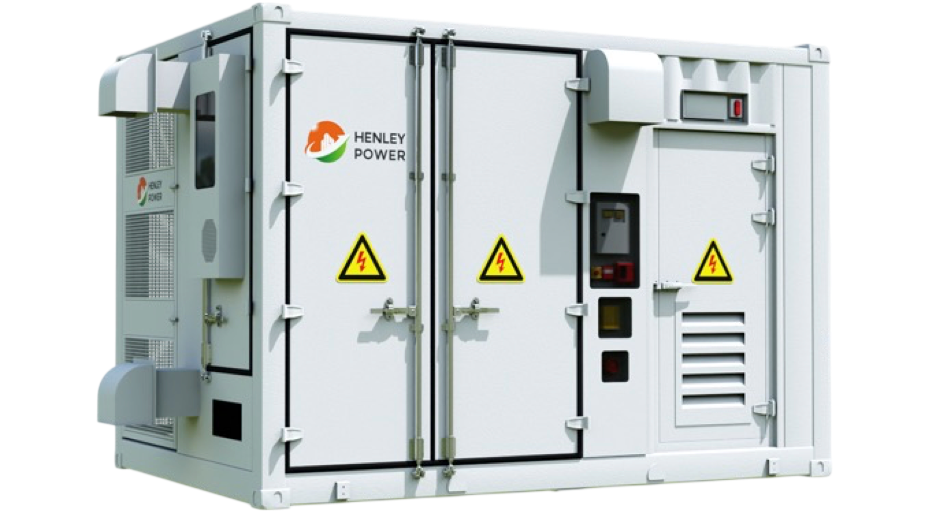
261 kWh liquid-cooled all-in-one cabinet
Integrated PCS, liquid-cooled, outdoor IP55. For C&I sites needing a turnkey solution without a separate inverter. Three deployment modes: integrated PCS, DC-only central PCS, or DC-only with hybrid inverter.

HLY-BESS-Utility-1MWh

1 MWh DC utility container
DC-only liquid-cooled container. 1,045 kWh at 832 Vdc nominal. Step up from C&I modular to utility scale. Pairs with external PCS 200 kW to 1.25 MW. Same 9-region service network.

HLY-Inverter-Hybrid

Hybrid inverter for Mode B pairing
Henley Power hybrid inverter, compatible with Mode B topology on the modular cluster. Combines PV input and battery DC bus. Sized 30–125 kW. Specifications and bankability package issued per project.

UTILITY

HLY-BESS-Utility-2MWh

Utility-Scale BESS — 2 MWh Containerised.

2 MWh

2,232 kWh liquid-cooled LFP in a 20-ft ISO container — IPP solar farms, wind balancing, utility substations.

View product

RESIDENTIAL · WALL-MOUNT

HLY-BESS-Residential-5kWh & 10kWh

HLY-BESS-Residential-5kWh & 10kWh

5 / 10 kWh

Wall-mount LFP home battery, two capacities. Wheeled chassis — no wall fixings. Parallel-expandable to 153.6 kWh.

View product

C&I · MODULAR · AIR-COOLED

HLY-BESS-Commercial-Industrial-Modular-16kWh

Modular HV stack BESS from 64 to 256 kWh.

64–256 kWh

Natural convection LFP. 16 kWh per module, 4–16 modules per cluster. Indoor IP21. DC-only with customer-supplied hybrid or central PCS.

View product