Solutions · Grid & Utility-Scale · Standalone

Grid-Scale Battery Storage

Standalone front-of-meter BESS for IPPs, utilities, and merchant operators. Capacity markets, ancillary services, wholesale arbitrage. Utility platform engineered for European TSO interconnection.
What is grid-scale battery storage
Grid-scale battery storage is standalone front-of-meter BESS — owned by IPPs, utilities, or merchant operators — that earns revenue from capacity markets, ancillary services (FCR-D, FFR, aFRR, mFRR), and wholesale arbitrage without being tethered to a single generation asset. Henley Power supplies the utility platform in 2 MWh and 5 MWh containerized blocks with grid-forming PCS as standard and IEC 61850-7-420 DER profile support. Chinese scale. Global service. Manufactured in Shandong, China. European projects serviced from Romania.

01 — THE GRID-SCALE BESS CASE

Why IPPs and utilities build standalone storage

Generation-tied storage is no longer the only economic pattern. Across European bidding zones, the revenue stack for standalone front-of-meter BESS has hardened into three layers — capacity, ancillary, arbitrage — without requiring a specific solar or wind asset to clear the financing model.

Capacity markets are the structural revenue floor. UK CRM, France’s mécanisme de capacité, Italy’s CapMech, Poland’s Rynek Mocy, Romania’s CRM, and Ireland’s Capacity Remuneration either pay BESS for de-rated MW availability or are extending eligibility to do so. The result is a multi-year derisked revenue line that anchors lender comfort. Capacity payments rarely cover full project IRR alone, but they pull the floor under the financing case before any spot-market revenue is modelled.

Ancillary services have become the margin layer. FCR-D, FFR, aFRR, and mFRR procurement under ENTSO-E network codes increasingly favour battery response over conventional plant. As inertia drops across European systems through 2026, the technical specification for primary frequency response now reads as a battery specification. Standalone BESS bid into these markets directly, without revenue-sharing with a paired generator.

Wholesale arbitrage is the residual upside. Day-ahead and intraday spreads in European zones stayed elevated and volatile through 2025 (EMMES 9.0 by EASE / LCP Delta; BNEF Energy Storage Market Outlook 1H 2026), driven by inflexible thermal retirement and rising renewable penetration. A 2–4 hour BESS cycling once or twice per day captures these spreads. The arbitrage layer is volatile and typically unfinanceable on its own, but stacked on top of capacity and ancillary contracts, it tightens the equity case.

02 — WHAT THE BATTERY DOES

Four revenue paths, one platform

Capacity firming

De-rated MW availability for capacity-market clearing. The battery commits to dispatchable delivery during scarcity hours, earning a multi-year contracted revenue line under the relevant national mechanism.

Frequency response

FCR-D, FFR, aFRR, and mFRR participation through grid-forming PCS. Sub-second response qualifying under ENTSO-E network code requirements. The margin layer above contracted capacity.

Wholesale arbitrage

Charge during low-priced day-ahead and intraday windows, discharge into evening peaks. One to two cycles per day on a 2–4 hour platform. Volatile by definition, but additive stacked above contracted capacity and ancillary revenue.

System strength & black-start

Grid-forming inverter capability provides voltage and frequency reference where conventional rotating mass is being retired. Selected projects qualify for black-start contracts and synthetic-inertia products under TSO-specific procurement.

03 — INTEGRATION ARCHITECTURE

Three deployment configurations

Standalone front-of-meter BESS isn’t a single architecture. The right configuration depends on whether the project is greenfield-substation or co-located with an existing generator, and how the operator structures the revenue stack contractually. The platform constants don’t change between modes: Tier-1 LFP cells from publicly listed manufacturers, multi-supplier homologated, and grid-forming PCS as standard across all utility BESS containers, with IEC 61850-7-420 DER profile support — project-specific edition confirmed at commissioning.

Mode A

Standalone front-of-meter

BESS containers wired into a dedicated MV substation with its own connection agreement. No generation pairing. Revenue stack is fully independent — capacity contract, ancillary bids, arbitrage all dispatched from the operator’s energy management system. Default for European IPP and merchant deployments.

Default

Mode B

Co-located with generation

BESS at the same point of common coupling as a wind, solar, or hybrid plant, but on its own metering and control envelope. Shares interconnection MW capacity with the generator under a hybrid PPA framework. Used where the connection queue makes new substations uneconomic and the host generator has spare interconnection headroom.

Mode C

Aggregated multi-site portfolio

Multiple BESS sites bid as a single virtual asset into capacity and ancillary markets through a portfolio-level EMS. Each site sized in 2–5 MWh increments for distributed grid services. Used by aggregators and utilities building geographically diversified storage fleets.

04 — SIZING LOGIC

How to size a standalone grid-scale BESS

Sizing is driven by three levers, in order of dominance for the financing case: contracted revenue floor first, then power rating, then dispatch duration.

Lever 01 — Capacity

De-rated MW commitment

Sets the MW the asset can credibly deliver during scarcity dispatch. Drives the capacity-market revenue floor and anchors the lender base case.

Lever 02 — Power

Ancillary contract size (MW)

Drives the PCS power rating. Frame against the FCR-D, FFR, aFRR, or mFRR contract MW the project intends to bid into.

Lever 03 — Duration

Arbitrage cycles per day (hours)

Drives the MWh-to-MW ratio. Single-cycle 2-hour platforms suit FCR-heavy markets; double-cycle 4-hour platforms suit deeper arbitrage and capacity-credit markets.

Rule of thumb

Merchant 50 MW / 100 MWh: typically a 2-hour platform for FCR-D and arbitrage stacking. Capacity-anchored 100 MW / 400 MWh: typically a 4-hour platform aligned to the national capacity-market clearing duration. Aggregated 5–10 MW sites: 2 MWh containers grouped into virtual portfolios. Starting points for feasibility only; detailed sizing studies factor in TSO interconnection rules, capacity-market de-rating curves, FCR/FFR price stacks, and intraday spread distributions.

Got a grid-scale project on your desk? We'll model the revenue stack with you.

05 — RECOMMENDED HENLEY PLATFORM

Two containerized blocks for European projects

The utility BESS platform is generation-agnostic and equally suited to standalone front-of-meter projects. Selection between 2 MWh and 5 MWh comes down to the contracted MW envelope, the duration target dictated by the capacity-market product, and the substation footprint at the connection point.

UTILITY

HLY-BESS-Utility-2MWh

Utility-Scale BESS — 2 MWh Containerised.

2 MWh

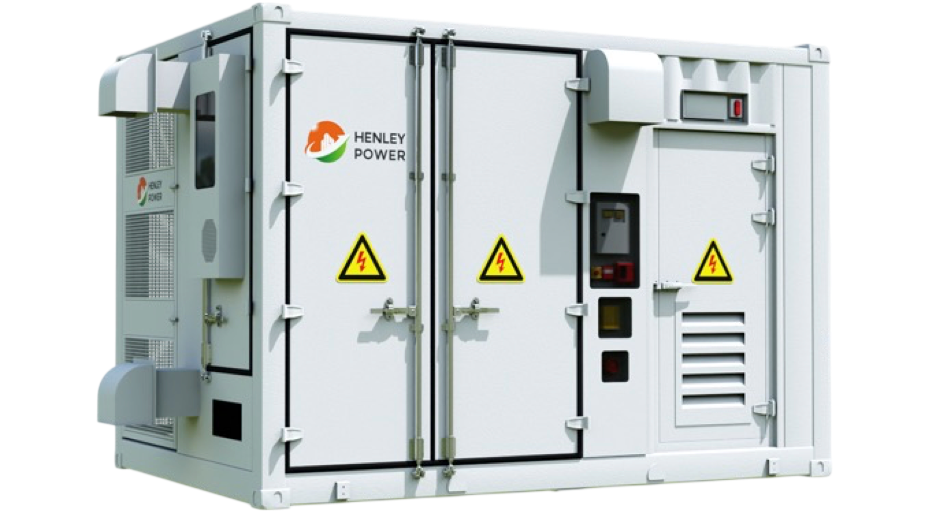
2,232 kWh liquid-cooled LFP in a 20-ft ISO container — IPP solar farms, wind balancing, utility substations.

View product

UTILITY

HLY-BESS-Utility-3MWh · 4MWh · 5MWh

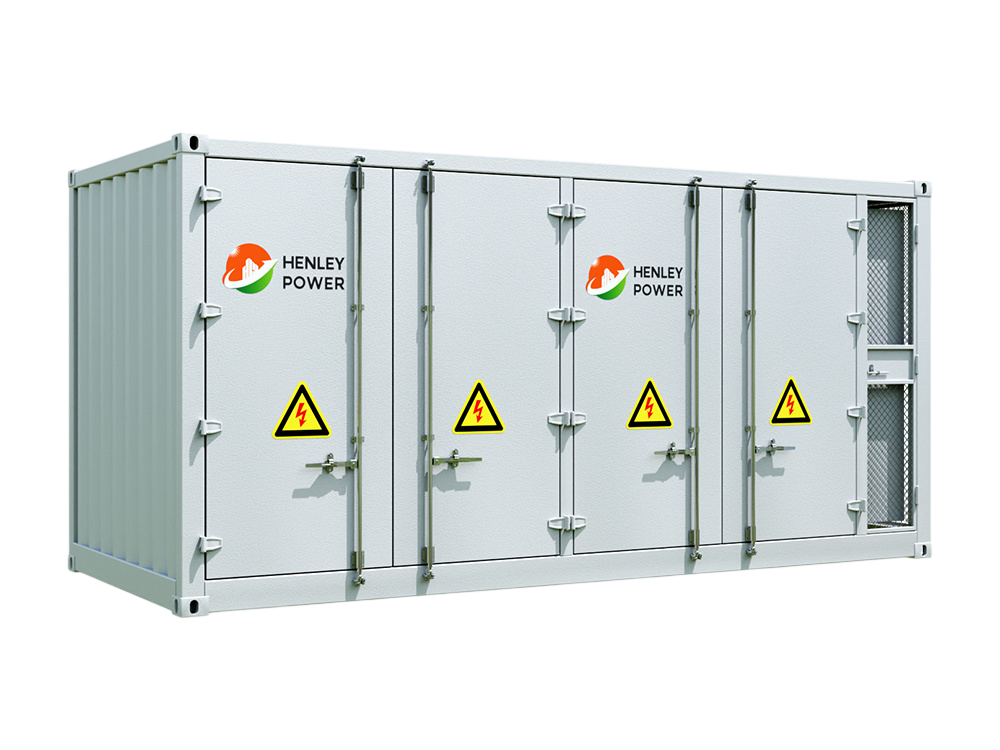
Utility-Scale BESS — 3 to 5 MWh Liquid-Cooled Container.

3–5 MWh

3,344 / 4,180 / 5,015 kWh liquid-cooled LFP in 20-ft ISO containers — grid-scale storage, frequency response, BESS-as-a-service.

View product

06 — REFERENCE PROJECTS

Honest about where we are

Note from engineering

Henley Power’s deployed portfolio is dominated by utility solar-plus-storage and PV-storage-diesel hybrids — Inner Mongolia, Ningxia, Hebei, Henan, Shandong provinces in China, plus a Sahel-region microgrid in Chad. European standalone front-of-meter grid-scale references are in development, with first projects targeted for commissioning across 2026–2027.

The technical reality is that the utility BESS platform — grid-forming PCS, Tier-1 LFP cells, 20 ft containerized form factor — is the same hardware deployed across China utility ESS projects today. European TSO differences live in the grid-code compliance points, EMS integration, and market-participation telemetry, not in the container or cell architecture. Pre-commissioning European references and engineering studies are shared after NDA on request.

If your project needs a fully European-deployed reference site as a pre-condition to specification, we’ll say so openly rather than over-promise. Browse current project portfolio →

07 — FAQ

Common questions

Can a standalone BESS be financed without a paired generator?
Yes — that’s the structural shift since 2024. Capacity-market revenue and ancillary contracts together provide enough contracted cash flow for lenders to underwrite the project without a paired generator. The contracted layers cover senior debt service; arbitrage upside flows to equity. Pure-merchant arbitrage-only projects remain hard to finance on conventional debt, but standalone capacity-plus-ancillary BESS is a lender-acceptable category across major European markets today.
Capacity-market eligibility is set per national mechanism: UK CRM, France’s mécanisme de capacité, Italy’s CapMech, Poland’s Rynek Mocy, Romania’s CRM, Ireland’s Capacity Remuneration. Each applies a de-rating factor to BESS that reflects expected scarcity-hour delivery, typically scaling with duration. Henley’s 4-hour configurations achieve materially better de-rating outcomes than 2-hour platforms. The de-rating curve is the single most important capacity-market input; project-specific qualification and bidding strategy is run with the operator’s commercial team during feasibility.
Warranty insurance via licensed European insurer is available as a project option for DFI-financed and institutionally-backed tenders. Parent guarantee or escrow alternative on request.
The PCS is grid-forming as standard across all utility BESS containers, with IEC 61850-7-420 DER profile support — project-specific edition confirmed at commissioning. ENTSO-E network code compatibility (RfG, DCC, HVDC where applicable) is engineered into the base platform. Specific TSO qualification confirmed per project during the connection-agreement workstream.
Anchor on the capacity-market product duration in your zone — 2-hour, 4-hour, or longer. Set MW against the contracted FCR/FFR/aFRR commitment to be bid. For typical merchant-plus-capacity projects in central or western Europe, 50–100 MW / 200–400 MWh in 5 MWh increments is the envelope we see most in 2026. Detailed sizing studies released after NDA.

08 — RELATED SOLUTIONS

Adjacent applications

Standalone grid-scale BESS sits alongside generation-paired and hybrid configurations on the same platform. Three closest siblings, in case the project mix calls for them.

PEAK SHAVING

C&I · DEMAND CHARGE

Peak Shaving & Demand Charge Reduction

Cut commercial and industrial demand charges 20–40% by discharging stored energy during 15-minute peak intervals. Stackable with time-of-use arbitrage.

View solution

WIND FARMS

WIND · OUTPUT SMOOTHING

Battery Storage for Wind Farms

Battery storage paired with onshore and offshore wind farms — output smoothing, curtailment recovery, ancillary services revenue.

View solution

SOLAR FARMS

SOLAR · CAPACITY FIRMING

Battery Storage for Solar Farms

Co-located battery storage for utility-scale solar PV plants — capacity firming, time-shift, and grid-export smoothing.

View solution